
We’re diving into a common issue many car owners face: that blinking “Water in Fuel” light on your dashboard. If you’ve noticed it flashing, especially in diesel vehicles, don’t panic—I’m here to explain why it happens and how the sensor works. We’ll keep this quick and simple, so stick around!

First off, let’s understand the basics. In modern cars, the fuel filter has a built-in sensor designed to detect water mixed in with your diesel. Why? Because water and diesel don’t mix well—water always settles at the bottom. This sensor is crucial in models like the m2di CR, where it’s positioned at the bottom, or in Power Plus variants, where the wiring might be higher up but still detects from the base.
Now, how does this water-in-fuel sensor actually work? It’s pretty straightforward—no fancy tech, just smart physics. Think of it like this: Diesel is an insulator, meaning it doesn’t conduct electricity well. Water, on the other hand, has minerals in it that allow a slight current to flow—not a shock, but enough for detection.
Let me break it down with a simple demo concept. Imagine a container filled with pure diesel. If you dip two metal probes (like positive and negative wires) into it and check with a multimeter, you’ll see zero voltage— no current flows. That’s because diesel blocks the electricity.
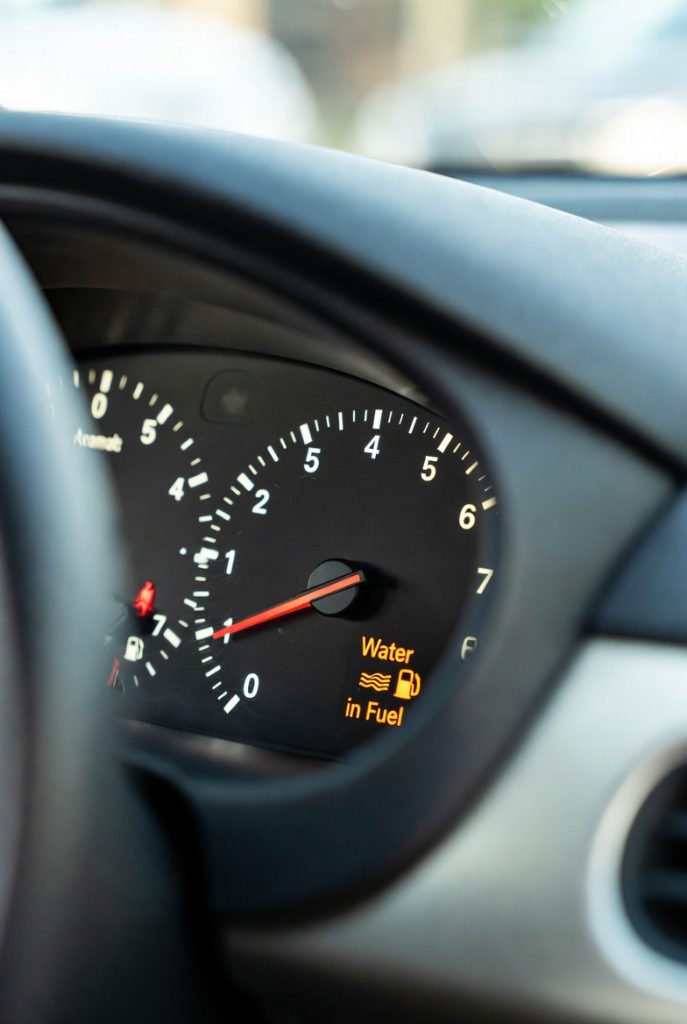
But add a bit of water? It sinks to the bottom, and suddenly, those probes pick up a tiny voltage, say around 11 points or so on the meter. That faint conductivity from the water’s minerals closes the circuit, triggering the sensor. In your car, this lights up the dashboard warning. In the m2di, the sensor’s right at the bottom for easy detection. In Power Plus, even if the connector’s up top, thick metal plates extend down to the base, doing the same job.
The key takeaway? If water gets into your diesel—from bad fuel or condensation—it’ll always pool low, and this sensor acts like a conductivity checker. It senses that slight current flow and alerts you before it damages your engine.
This applies to pretty much any diesel vehicle out there—the principle is the same. So, next time that light blinks, drain the water from your filter pronto to avoid bigger issues. How’d you like this quick explainer?